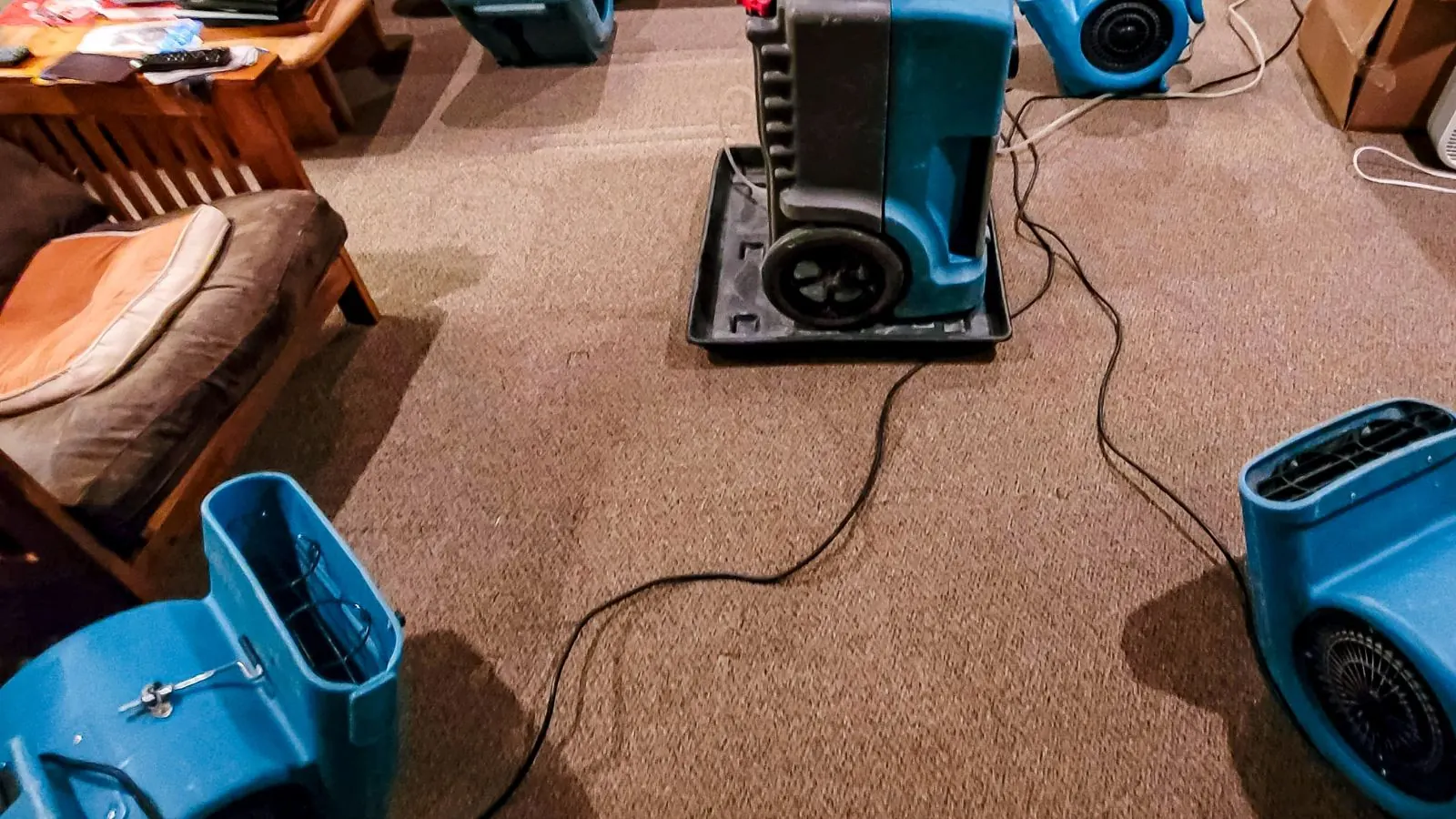
After the standing water is gone, the building is still wet. Drywall, framing, subfloor, concrete and insulation hold moisture and release it into the air for days. Structural drying is the process of pulling that moisture out with air movers, dehumidifiers and moisture readings. In the trade it is also called water mitigation.
Structural drying and dehumidification in Chester, PA is the step that prevents mold, warped floors and repeated paint failures. If your walls feel damp, a floor is cupping, or a musty smell has set in, this page explains what a proper dry-down looks like.
Why do my walls feel damp after the water is gone?
That is the question most people actually ask. Surface water is removed by extraction, but the materials soaked it up. Wet drywall feels cool and a little soft. Wet wood floors cup, and wet carpet pads stay heavy. Musty odor means moisture is sitting somewhere.
The answer is to measure, not guess. A moisture meter reads each material. A thermal imaging camera shows cold, wet areas behind paint. A hygrometer reads the humidity in the air. Those three tools make a moisture map of the building.
Twin and row houses with shared walls need readings on both faces of a party wall, as the West End water damage restoration page explains.
How moisture mapping works
On day one the crew takes a baseline: readings on the wettest wall, readings on a dry wall in the same house for comparison, and air temperature and humidity. These form the dry standard for that building, because every house starts from a different baseline.
Readings are written down and repeated each visit. Equipment stays until wet materials match the dry standard. When readings stall, the crew changes the setup instead of just waiting.
The equipment and what each piece does
| Equipment | What it does |
|---|---|
| Air movers | Push air across wet surfaces to pull moisture off the material. |
| LGR dehumidifiers | Remove moisture from the air so surfaces can keep releasing water. |
| Moisture meters | Give a number for drywall, wood and concrete. |
| Thermal imaging camera | Shows cool, wet areas behind finished surfaces. |
| Containment and drilling | Lets crews dry wall cavities and under cabinets without full demolition. |
LGR stands for low grain refrigerant. These units pull more water per day than a hardware store dehumidifier, which is why they are used in restoration. The ANSI/IICRC S500 standard describes drying goals and documentation, and you can ask any company whether its crews follow it.
Need a moisture reading and drying plan? Call us.
☎ (856) 702-0892Water mitigation versus restoration
Mitigation stops further damage. Restoration returns the building to pre-loss condition. Drying is the heart of mitigation, and it should be finished before anyone paints or installs new flooring.
Drying often begins the same day as water extraction. For a burst line, see burst pipe water damage, and for wet walls see wall and drywall water damage. Wet carpet is covered on the carpet water damage page.
How long drying takes
It is measured in days, not hours. How many depends on the water category, the materials, how long they sat wet, the season and the equipment. Concrete and thick framing dry slowest. If a company promises a fixed number of days before seeing the loss, ask how they will measure it.
If materials stayed wet for more than a day or two, ask about mold checks, and see mold remediation.
Cost factors and insurance
- Affected area and materials. Concrete and thick framing take longer.
- Equipment days. Cost follows the number of units and days.
- Water category. Contaminated water adds protective steps.
- Monitoring visits. Readings each day are part of the job.
Drying is often part of a covered sudden water loss. Check your policy or ask your insurer, and keep the daily moisture logs, since they document the work. Call (856) 702-0892 for a scope conversation. Scope and price are explained before work starts.
Common questions
Can I dry my house with box fans and a hardware store dehumidifier?
For a small spill, yes. For wet drywall, wet subfloors or any loss that sat for more than a day, those tools do not reach inside the materials. Measure with a meter before you decide.
How do you know when it is dry?
Moisture readings are compared with the dry standard from an unaffected area of the same building. The equipment stays until the numbers match.
Is drying covered under water mitigation?
Yes. Mitigation includes extraction, drying and monitoring. Restoration is the rebuild afterwards.
Do I need to run the equipment all day?
Yes. Equipment runs continuously. It is loud and uses electricity, but turning it off slows the work.
Can drying prevent mold?
Fast, complete drying lowers the risk. Mold needs moisture, so removing moisture is the main prevention.
Still have a question? A dispatcher can answer it by phone any hour.
☎ (856) 702-0892